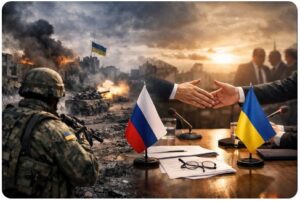
The Russia-Ukraine conflict continues to command global attention as it unfolds on two parallel fronts: the battlefield and the negotiating table. While major assaults intensify in contested regions, diplomatic channels remain active, reflecting a war that is no longer defined solely by military movement, but by endurance, messaging, and global stakes.
On the ground, fighting remains fierce. Urban centers and strategic infrastructure have faced repeated strikes, underscoring how modern warfare increasingly targets systems that sustain daily life. Energy facilities, transport routes, and supply hubs have become focal points, disrupting civilian routines and adding pressure beyond the front lines. These developments highlight a grim reality: even when territorial changes are limited, the human and economic costs continue to rise.
Both sides are adapting. Military strategies now emphasize precision, intelligence, and resilience rather than sweeping advances. Defense systems, electronic warfare, and rapid mobilization play central roles, revealing how the conflict has evolved into a prolonged test of capacity rather than a short campaign of decisive victories. Each escalation appears calibrated, not only for tactical gain, but for political signaling to allies and adversaries alike.
At the same time, diplomacy has not disappeared. Quiet negotiations, indirect talks, and international mediation efforts persist, often away from headlines. These discussions rarely deliver immediate breakthroughs, but they shape expectations and boundaries. Statements from officials suggest that while compromise remains difficult, dialogue is seen as necessary to manage risks and prevent broader instability.
Global involvement adds another layer of complexity. Economic sanctions, military assistance, and humanitarian aid have drawn nations into the conflict without direct combat. As a result, the war’s impact extends far beyond Eastern Europe, influencing energy markets, food security, and geopolitical alignments worldwide. For many governments, the conflict has become a defining factor in foreign policy decisions.
Public sentiment is also shifting. Initial shock has given way to fatigue in some regions, while in others, concern has deepened as the war shows no clear end. This emotional evolution matters, because public support influences political will, funding decisions, and long-term commitments.
What makes the Russia–Ukraine conflict particularly significant today is not just its intensity, but its duration. Prolonged wars reshape societies, normalize uncertainty, and test international systems designed to prevent escalation. The coexistence of heavy assaults and ongoing diplomacy reflects this reality: neither side appears ready to fully abandon force or conversation.
As the conflict continues to trend in global discourse, it serves as a reminder that modern wars are rarely linear. They advance through cycles of violence, pause through negotiation, and persist through unresolved tensions. The world watches not only for who gains ground, but for whether dialogue can eventually outweigh destruction.